


The German-British #Freundship Award is a symbol of the special bond between Germany and the United Kingdom. It was established in 2021 by the British Chamber of Commerce in Germany (BCCG) and the British Embassy in Berlin to celebrate the centuries-old shared history, the close cultural ties, and the many economic, scientific, and social connections between the two countries.
This award honours individuals who exemplify this friendship through their life and work. They have made exceptional contributions to fostering dialogue, mutual understanding, and closer relations between our two nations – actively helping to shape a spirit of European and international community.
Luzius Alexander Ziermann
Alexander Luzius Ziermann was born in 1959 in Frankfurt am Main. Using a wide range of techniques and media, he transforms natural forms – those that appear repeatedly in nature, both on a grand scale and in the microscopic realm –into unique works of art.
In 2006, the artist began creating reflective art landscapes around the world using discarded car side mirrors, with installations in locations such as Namibia, Lanzarote, Ireland, and Italy. Inspired by the Fairy Circles along the Namib Road, he transformed an ET Jaguar into a total work of art in 2014, which he staged in various ways. The forms depicted on it have since found expression in several plexiglass sculptures.
Two years ago, he began the series “A Piece of Ocean”, in which he captures a real moment of a moving sea surface digitally and reproduces it within a milled plexiglass block.
Ziermann’s works are represented in museums and collections around the world, including the Barz Collection and the DZ Bank Art Collection.
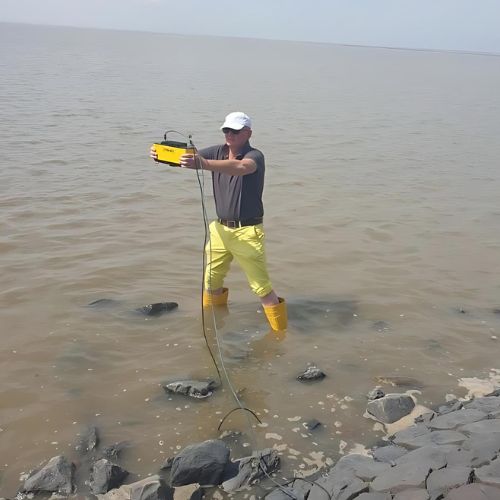
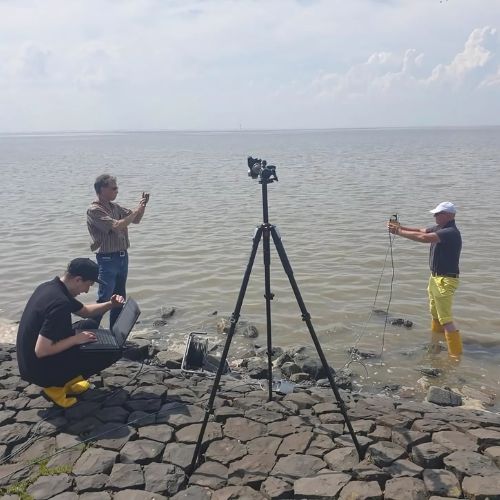
The creation of the Award required considerable time and organizational effort. Particularly noteworthy were the numerous trips to the North Sea, which were necessary to precisely measure the water’s surface. Equally crucial was the subsequent data processing in Regensburg, which laid the foundation for the next stages of the project. In Siegerland, the plexiglass block – sourced from Italy – was milled with millimeter precision in a specialized workshop. A decisive step followed in another workshop: by treating the surface with fire, the material achieved its characteristic transparency and shine.
The technical recordings at the North Sea also represented a remarkable highlight. Over the course of three days, detailed data were collected using a specialized camera in collaboration with an expert from Jena. To operate the equipment in the tidal flats, a reliable power source had to be arranged – fortunately, the appropriate generator was available.
Equally important was the expert support provided throughout the project. A professor of photogrammetry from Hannover offered professional advice, while another key contribution came from the University of Applied Sciences Frankfurt, which provided a fluorescent liquid for the work.
In this artwork, scientific precision, masterful craftsmanship, and artistic vision are united in an impressive and harmonious way.